Helix World +
Theory of electric and magnetic field in electromagnetic waves
1 Electromagnetic waves have no electric field - 日本語 - <Reference 王様は裸>
2 Unclear about radio waves - 日本語 -
3 Form of current - 日本語 - <Reference Comment>
4 Electrical and Magnetic forces - 日本語 -
5 Electromagnetic waves are traveling magnetic fields - 日本語 -
6 Generate electromagnetic waves - 日本語 -
7 Receive electromagnetic waves - 日本語 -
8 Polarization - 日本語 -
9 Insertion device for synchrotron - 日本語 -
10 Longitudinal and Transverse Waves - 日本語 -
11 Vibration of string - 日本語 -
Sept./05/2023
< 1 Supplement on synchrotron light >
Figure 1 shows the schematic configuration of an insertion device such as a wiggler or undulator that is attached to the synchrotron as described in "Electromagnetic waves are traveling magnetic fields" above.
When electrons input from the left of the screen pass between deflection magnets, their direction of travel is bent by the Lorentz force. And, like a synchrotron, it also outputs a traveling magnetic field (light).
By using multiple deflection magnets, the number of times the direction of travel is bent increases, enhancing the electrons and a traveling magnetic field (light) generated.
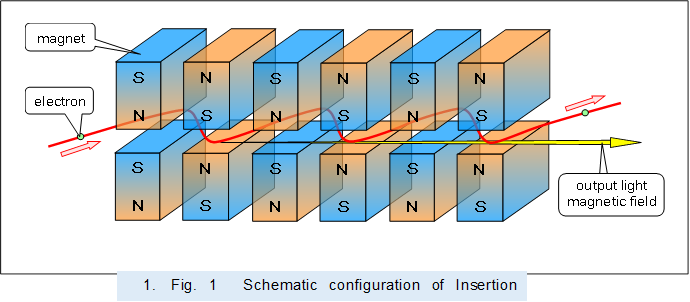 |
Figure 2 shows how the electrons in the electron stream vibrate and output a traveling magnetic field (light), when the electron that is bent in the direction of travel and jumps out interrupts the other electron stream.
The vibration in the electron flow produced by interruption of the electron travels at the speed of light with a magnetic field, just like the vibration of the electrons forming a current in a conductor.
In this case, the energy of the interrupted electron is added to the energy had by the flowing electron and amplified, and outputs a strong traveling magnetic field (light).
The figure shows how the electron in blue interrupts the electron flow from the left to the right of the screen, producing a longitudinal wave of electrons in the electron flow due to the increased electron density in the area.
Then, the denser areas (vibrations that form longitudinal waves) overtake the electron flow and propagate to the right at the speed of light.


 |
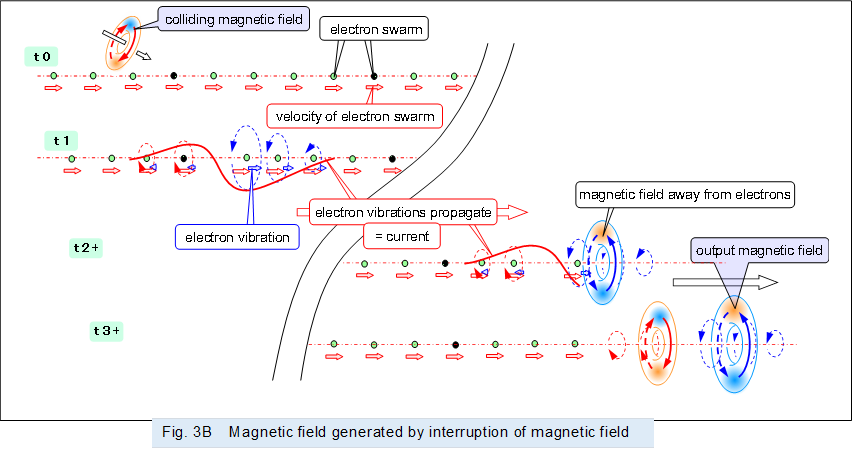
Figure 3 shows how the electrons in the electron stream vibrate and output a traveling magnetic field (light), when the traveling magnetic field (light) jumps away from the electrons and interrupts the other electron stream.
Same as above, the vibration in the electron flow produced by interruption of the traveling magnetic field (light) travels at the speed of light with a magnetic field, just like the vibration of the electrons forming a current in a conductor.
In this case, the energy of the interrupted traveling magnetic field (light) is added to the energy had by the flowing electron and amplified, and outputs a strong traveling magnetic field (light).
The figure shows how the magnetic field (light) interrupts the electron flow from the left to the right of the screen, producing a longitudinal wave of electrons in the electron flow due to the decreased electron density in the area.
Then, the sparser areas (vibrations that form longitudinal waves) overtake the electron flow and propagate to the right at the speed of light.


 |
Incidentally, laser light can also be injected external as a traveling magnetic field (light) to produce vibrations in the electron flow. When monochromatic light (single frequency electromagnetic wave) is injected to synchronize the vibration of the electrons formed in the electron flow, it can be used as an amplifier for monochromatic light.
< 2 Supplement on photon >
As described above, in synchrotron and insertion device, even if electrons are not accelerated to the full speed of light, vibrations can be produced in clusters in the electron stream, which can produce an electric current and accompanying magnetic field.
The magnetic field can be separated from the cluster of electrons by a deflection magnetic field to output a corresponding traveling magnetic field (light).
Looking at it another way, a synchrotron, where electrons do not reach the speed of light, cannot produce an ideal photon generated from a single electron moving at the speed of light, as shown above in "Electromagnetic waves are traveling magnetic fields".